The Lake Whitefish are a slightly deep-bodied fish, oval in cross-section. They have a greenish-brown back, silvery sides, silvery-white belly, and a snout that overhangs their mouth. They have 2 flaps of skin between the nostrils, and a deeply forked tail. They grow between 30 cm – 65 cm in length, and weigh roughly 0.9 – 1.8 kilograms. The Ontario record for largest Lake Whitefish is 6.7 kilograms.
The Lake Whitefish live in the Great Lakes, and deep, cold inland lakes throughout Ontario. They prefer the deep sections of deep lakes and shallow sections of Far North lakes. The Lake Whitefish move into rivers and streams to feed in the early spring–often found in deeper pools behind spawning beds. They can be found in deeper waters during the summer, and move to shoals of large lakes and rivers during the late fall and early winter.
The Largemouth bass are medium-sized, deep-bodied fish, with back and sides that are green to olive, and a belly that is yellow to white. They have a broken horizontal stripe along their body, with 9 to 11 dorsal fin spines; a deep notch between dorsal fins. Unlike the Smallmouth Bass, the Largemouth Bass have an upper jaw that extends beyond the eye.
The Largemouth Bass can grow between 25 cm – 55 cm, with a weight of 0.7 – 1.8 kilograms. The Ontario record for biggest Largemouth Bass is 4.7 kilograms.
These fish can be best found in southern Ontario through the lower Great Lakes, with some populations in Northwestern Ontario. They like to live in warm, weedy water or clear, rocky lakes. They can also be found living in shallow muddy ponds, or slow-moving rivers.
The Muskellunge (Muskie) is a very large, elongated fish (second-largest in Ontario). It has dark vertical bands on light background, at times spotted or clear, with a green-gold, brown, grey or silver back. It has lighter sides, with a beige to white belly. While this fish is similar to the Northern Pike, the Muskie has tips of tail fin more pointed than that of the Northern Pike. It can grow anywhere between 71 cm – 137 cm, with a weight of 4 – 11 kilograms.
The Ontario record for biggest Muskie weighed 29.5 kilograms.
The Muskie like to be concealed among aquatic plants at the sides of channels, and rocks and offshore shoals in lakes and rivers in summer. Peak fishing periods are in June and in the fall when water temperatures begin to cool. To get a good medium-sized fish, your best bet is in the summer months when they’re more plentiful.


The Pike fish, also known as the Northern Pike or Jackfish, have very large, elongated bodies, dark green to brown body with light, yellowish or white spots, a dark back that fades to creamy white belly with tips of tail fin more rounded than muskellunge (muskie). They can grow anywhere between 45 cm – 75 cm, and weigh around 0.9 – 4.3 kilograms. The Ontario record for biggest Pike is 19.1 kilograms.
These fish are aggressive feeders, and can be caught year round. They like to live in vegetated bays, creek mouths, and shoals of lakes; a good spot for them to ambush prey. They like to find deep water in the summer to avoid the higher water temperatures, minus the northern areas.
The Pike fish are widely distributed throughout most of the province. While they are not historically found in parts of central Ontario, they are gradually expanding into these areas.
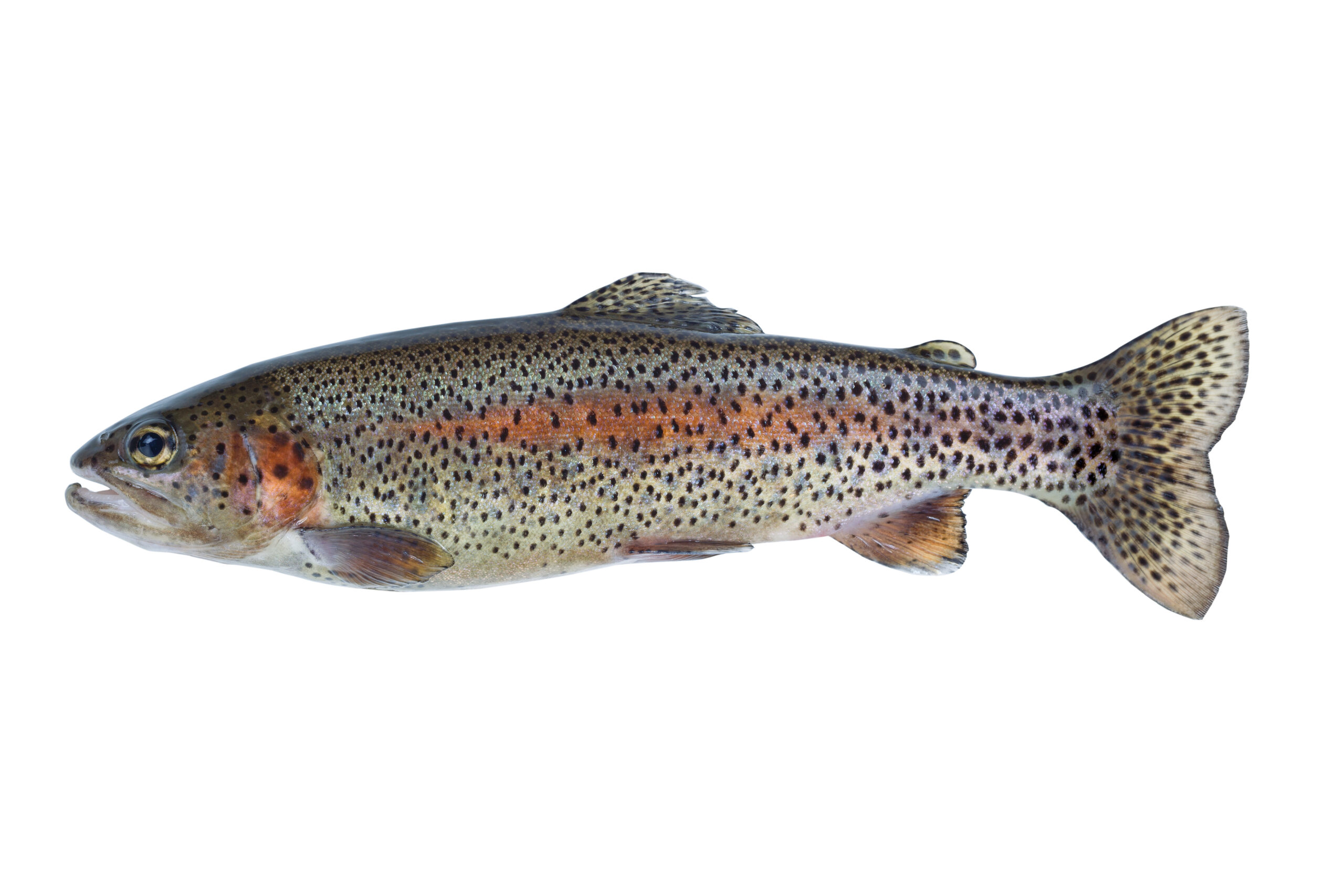
The Rainbow Trout feature a silver body with many small dark spots, with radiating rows of spots over their tail. Their mouth and gums are often white, and there’s a pink lateral stripe often present. The Great Lakes Rainbow Trout is usually larger; while the inland lakes Rainbow Trout usually has a more prominent pink stripe. They grow between 20 cm – 60 cm, and weigh anywhere between 0.5 – 6.8 kilograms. The Ontario record for largest Rainbow Trout is 18.5 kilograms.
These fish were introduced into the Great Lakes from the Pacific Coast, and were widely distributed in the Great Lakes and their tributaries, and in some inland lakes. The Rainbow Trout or Steelhead Trout like cold streams, some warm streams. They enjoy swift, turbulent water, and can live in a range of conditions in rivers, ponds, and lakes.
The Smallmouth Bass are medium-sized, deep-bodied fish, with green to olive back and sides, and yellow to white belly. Their bodies often have dark vertical broken bars, with 9 – 11 dorsal fin spines, a shallow notch between dorsal fins, and an upper jaw that does not extend beyond the eye.
The Smallmouth Bass can grow between 25 cm – 50 cm, with a weight of 0.5 – 1.6 kilograms. The Ontario record for biggest Smallmouth Bass is 4.5 kilograms.
These fish can be found in the Great Lakes watershed, the St. Lawrence River, and northward beyond Lake Nipissing. In recent years they have been introduced into many areas of Northwestern Ontario. The Smallmouth Bass like to live in clear, rocky lakes and rivers, along shoreline rocks and points, offshore shoals, and in deep water. They have a similar habitat to that of the Trout, but with a wider range of temperatures.


Smelts are a family of small fish, that are also known as freshwater smelts or typical smelts. Some smelt species are common in the Great Lakes, where they run in large schools along the saltwater coastline during spring migration to their spawning streams. Smelts usually grow between 20 cm – 70 cm. Smelts are a food source for many fish, including salmon, striped bass, and lake trout.
Around the Great Lakes, “smelt dipping” is a common group sport in the early spring and when stream waters reach around 4 °C. Fish are spotted using a flashlight or headlamp and scooped out of the water using a dip net made of nylon or metal mesh.
Walleye are large, elongated fish. Their back is olive-green to brown; sides paler with yellow flecks. They have no distinct blotches or bands as adults. They have a white tip on their lower tail fin, with their spiny and soft dorsal fins separated. Their large mouth extends below back edge of eye, and they have large teeth. They typically grow anywhere between 35.5 cm – 58.4 cm, and weigh 0.68 – 1.36 kilograms. The Ontario record for largest Walleye is 10.1 kilograms.
The Walleye or Pickerel can be found throughout Ontario, and are especially common in the Great Lakes basin and Northern Ontario. Their habitat includes a range of river and lake conditions. This includes anywhere from cold, clear water to warm, weedy and stained water. They like soft mud bottoms to flooded timber, rubble or bedrock, and preferred cover – things like weed, wood, and rocks.
The Yellow Perch have a light yellow body, with 6 to 8 dark, vertical bands on their sides. They have 2 separate dorsal fins, and a large mouth, extending to below the middle of the eye. They can grow between 15 cm – 30 cm, and they roughly weigh 0.35 kilograms. The Ontario record for largest Yellow Perch is 1.1 kilograms.
The Yellow Perch can be found widely distributed across the province. The Yellow Perch can tolerate a variety of temperatures and habitats, but prefer areas of open water and moderate vegetation. They share a habitat with Walleye and Bass.